
8 Styles of Toys and Games to Build Your Montessori Homeschool or Playroom
- bringingitbacktoba
- Sep 21, 2023
- 8 min read
Updated: Mar 15, 2024
Montessori education is an approach to learning that is based on the principles developed by Dr. Maria Montessori in the early 20th century. This learning style is characterized by a child-centered, hands-on approach to education that emphasizes independence, self-directed learning, and individualized instruction. There are many benefits to a Montessori style education and learning, including, but not limited to the following:
Child-centered approach to learning, recognizing each child has unique needs, interests, and pace of learning, in turn, empowering children to express their needs and interests.
Fosters independence by allowing children to choose their areas of interest, activities, and pace of learning, supporting the development of self-reliance and responsibility.
Encourages hands-on learning and focuses on practical life skills. This approach allows children to explore through experiences and better prepares children for real-world tasks while building their self-confidence.
Emphasizes creativity and critical thinking by encouraging children to ask questions, explore topics of interest deeply, and problem solve independently and at their own pace.
Fosters a broader world view and greater empathy for others through a focus on cultural awareness by incorporating a global perspective which exposes children to different cultures, languages, and traditions.
Research also suggests that Montessori-educated children tend to develop strong academic, social, and emotional skills. They often excel in problem-solving, decision-making, and adaptability, which can benefit them throughout their lives. Many parents and educators believe that Montessori principles offer a holistic and effective way to nurture children's development and love for learning.
Okay, now what do you do with all that information? As a parent navigating children’s educational toys and games, it can be hard to know where to start. Well, let me help take a little bit of the guesswork out of the equation for you. Here is a list of 8 types of Montessori based toys, games and activities that will help build your homeschool or playroom. *Post may contain affiliate links*
1. Montessori Sorting and Matching Toys: These can include toys with different shapes, colors, or textures that children can sort, match, and categorize. The most cost efficient options are those which can grow and evolve with kids and encompass a variety of skills within one toy or game set. Some of my favorites are sorting toys like these, which I like because you can sort by color and count the animals, as well as working on motor skills by grabbing and grasping with the tongs to sort into the corresponding cups.

Or these sorting tubes which allow sorting by color or shapes, focus on motor skills by grabbing and grasping with the tongs to sort into the tubes, but also helps with cognition and developing coordination via pattern matching as well as practicing counting skills.
2. Montessori Wooden Puzzles: Wooden puzzles with various shapes, letters, or numbers can help with fine motor skills and cognitive development. Puzzles like this are great, because even when your child “outgrows” the difficulty level of the puzzle, you may find that they still enjoy going back and doing them. We have always played racing games with them (Ex: see how much of the puzzle I can get done before you run to the end of the hall and back). My kids love seeing if they can get back before I finish the puzzle and vice-versa, which is excellent for developing their hand-eye coordination and fine motor skills. I love this pack that comes with 3 puzzles that cover numbers, letters, and shapes, and the pegs make them easy to hold onto and place, plus your child gets to practice grabbing and pinching.

Melissa and Doug brand also has a variety of wonderful puzzles and have been some of our favorites over the years. You really can’t go wrong with any of them.
3. Montessori Sensory Toys: This can be any toys that engage a child's senses, such as textured balls, sensory bins, or sensory boards. There are so many benefits to sensory toys and materials. One of my favorite brands of sensory kits by far comes from a small, in-home business, but the quality just can’t be beat. Penny Rose Play Kits specializes in dough and rice kits, but also does party favor dough jars and I-spy jars. These kits are beautifully handcrafted and keep my kids occupied for hours! Anything that can do that, and be supporting their cognitive development is a win in my book. You can check them out and order yours here.


As simple as they are, these pop tube sensory toys are a surprise favorite among kids I know. My sister showed up to the beach with these one day, and I never expected them to be such a hit, but 4 kids, and these were the favorite all day for all of them. They are noisy, but man did the kids love them.
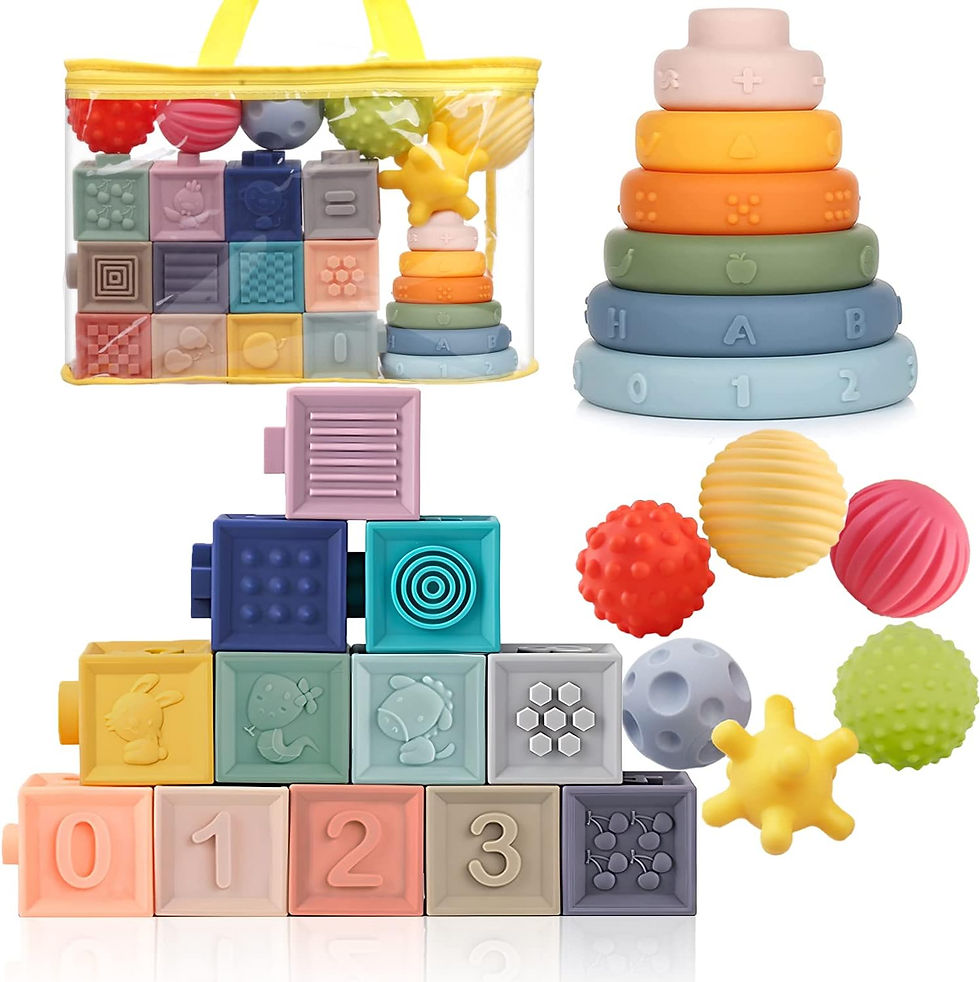
Not to forget about our youngest learners, sets such as this one are a great choice and focuses on shapes, textures, and stacking, supporting motor skills and cognition. While, sensory boards like this one are also a huge hit, and are available in so many styles and developmental levels.
4. Montessori Math and Bead Materials: A great place to start is to look for math materials like number rods, and math puzzles that help children learn math concepts through hands-on activities. Math Beads and other bead materials are an excellent choice for learning concepts like addition, subtraction, multiplication, and division.
Hands-on learning can make a big difference when practicing challenging concepts such as counting and mathematics. I love sets like this board and peg set for teaching the basics of number recognition and counting.

You can even expand upon this set, but adding rice or sand on the trays and allow the child to draw the numbers in the sand or rice, or they can mold the numbers with dough.
For beginning math skills, this mathematics game set is great, it is very visual and hands on to practice the basic concepts of mathematics.

As you move up and start looking at concepts of fractions, we have had a lot of success with visual sets such as these fraction equivalence cubes, or fraction circles, which allow hands-on, side by side comparisons of the different values
5. Montessori Language Materials: Materials like sandpaper letters and phonics games can assist in language development.
One of the favorite language games we have is Zingo. The objective of the game is to be the first person to match all the words on your Zingo card with the tiles that are displayed on each turn. Each card has a variety of sight words on it, along with high contrast and bright imagery. Each turn two tiles are displayed and the first person to identify if a tile matches their game card gets to keep the tile. This is perfect for early and pre-readers to help develop those early reading skills such as phonics and recognition of sight words.
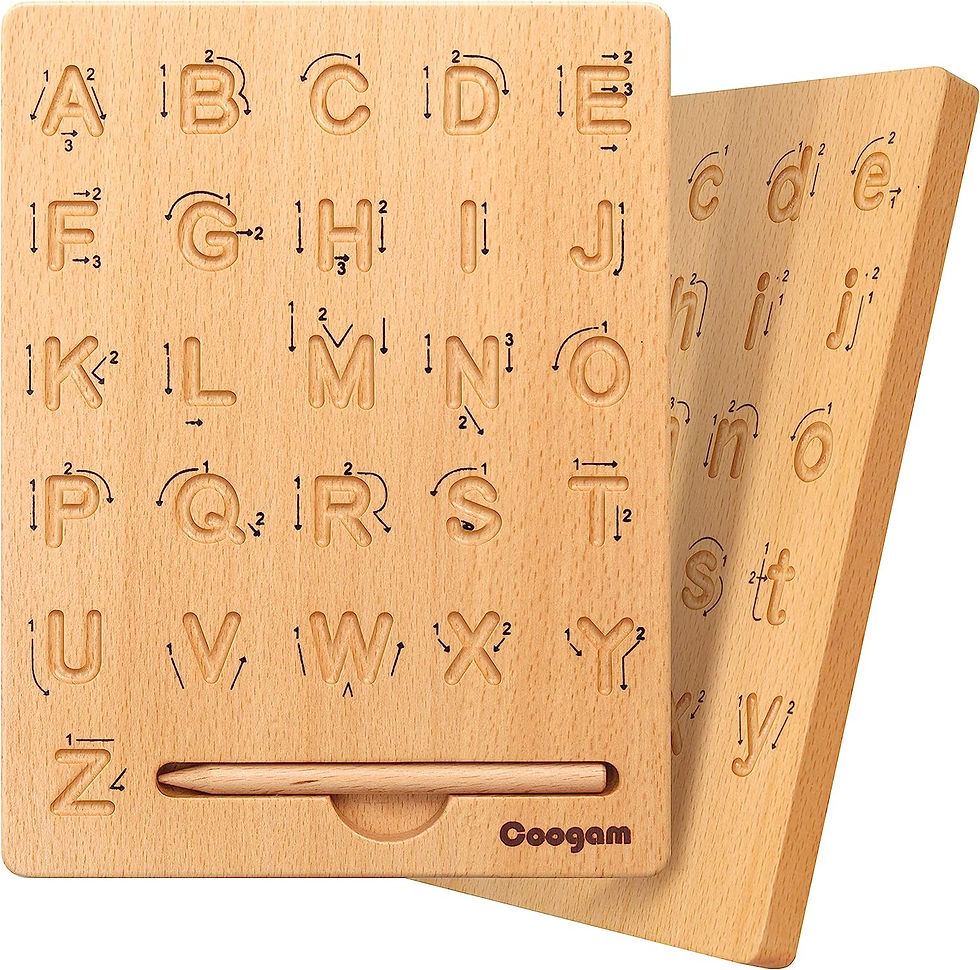
As your child gets a little older and is working on those beginning writing skills, alphabet tracing boards like this one are a great resource, and really support those fine motor skills.
6. Montessori Practical Life Activities: These can include child-sized tools for activities like pouring, scooping, and food preparation.

One of the cornerstones of Montessori learning is hands-on learning and learning through activities that teach or focus on development of practical life skills. One of our favorite ways to get our kids involved is helping in the kitchen. This toddler kitchen utensil set offers a host of tools that can empower toddlers to gain skills to prepare foods (with adult supervision, of course).
We also love a tower like this to help get our kids up to counter height for easy working, or even just color, draw, or play near us while we work in the kitchen. In my experience kids love scooping and pouring, and working in the kitchen is an excellent opportunity to practice those skills as well.
7. Montessori Geography and Science Kits: These are kits that explore geography, biology, and other sciences in an engaging and hands-on way, often using maps, globes, or nature-themed materials.
If you’re anything like me, you may not always feel like you have the adequate skill set to “teach” some subjects. This is where Montessori learning can truly shine. Rather than reading endlessly from a book or a lesson plan to teach detailed subjects packed with memory work and dry information, you can look to things like games, kits, and hands on, interactive activities to help support these ideas, and allow children to develop their own connections within the material.

For science, I love the collection of National Geographic Science Kits. These are so versatile, and hands on, making any of them a great choice to integrate into whatever lesson plans or topics you are covering.
Another great place to find hands-on resources and learning kits for all ages is KiwiCo. Their kits are broken down by age (all the way down to 0-2) and span a variety of topics and interests, including science and STEM projects. Projects can be purchased individually or you can subscribe to get a new box each month.
To make science fun and on the go, wherever you are, this little portable microscope is likely to keep your kids entertained for hours. I mean, who doesn’t love seeing the world and nature up close?
Geography can really be learned the best by experiencing and exploring the world around you. What region do you live in? Are you on the coast? Near the mountains? On the plains? Wherever you are, take a look around and study the land forms near you, learn about natural disasters you need to be prepared for in your area, explore critters and wildlife living in your region. For example, if you live near a coast, what body of water is it? Is it the ocean? Is it a bay or other inlet? Do you live on a peninsula? Go to the beach and observe and talk together about the things you are seeing and noticing - what marine life is around?

Things like that are all real life and practical (relatable) ways to teach about the geography around you. You can also use land form puzzle cards like these to supplement and further support the work you are doing.
For a more general world geography of identifying countries, maps like this one are great to start those conversations and encourage further learning about different regions of the world and different cultures.

8. Montessori Art Supplies: Think materials like clay, colored pencils, and paper that encourage creativity and fine motor skills. This really doesn’t have to be as “fancy” as it sounds. Art supplies are great in any capacity if they promote and foster creativity and open ended creation. This can be crayons or colored pencils, paints, clay, stamps, or reusing things around the house (popsicle sticks, tp/paper towel rolls, egg cartons, etc). I do however really like this stamp set from Melissa and Doug.
I have also found that my kids really enjoy dot markers. The bonus, these are easy for little hands to grasp as well, making them great for a large age range (with appropriate supervision based on child’s age and maturity, of course).
When it comes down to it, we are all just trying to do and provide the best opportunities for our kids or the kids we teach. Children, especially at young ages, learn so much more through play and daily experiences, and for that reason, I feel it is so important to nurture that natural curiosity and creativity they have. It doesn’t have to be fancy or have a label, and it doesn’t have to be all or nothing. Every child is different, and as such, what works for one family will not work for every family. Follow your child’s lead, foster their passions and interests, and let me know if I’m missing any of your personal “must haves” on my list.
You can also check out my post outlining my 3 personal favorite Homeschool Curricula HERE, or my post explaining the foundations and values of 12 different types of homeschooling HERE, and don't forget to subscribe at the bottom of the page for email updates and exclusive updates and offers.


Comments